Remote Patient Monitoring in Home Care: The Role of IoT Devices in Enabling Early Intervention
By SMPLSINNOVATION — because health tech doesn’t have to be boring.
Introduction
Health care is changing fast. More people want care at home instead of at the hospital. Chronic illness is common, with nearly 6 out of 10 adults in the U.S. living with at least one condition in 2025. Hospital stays cost a lot, for both patients and providers.
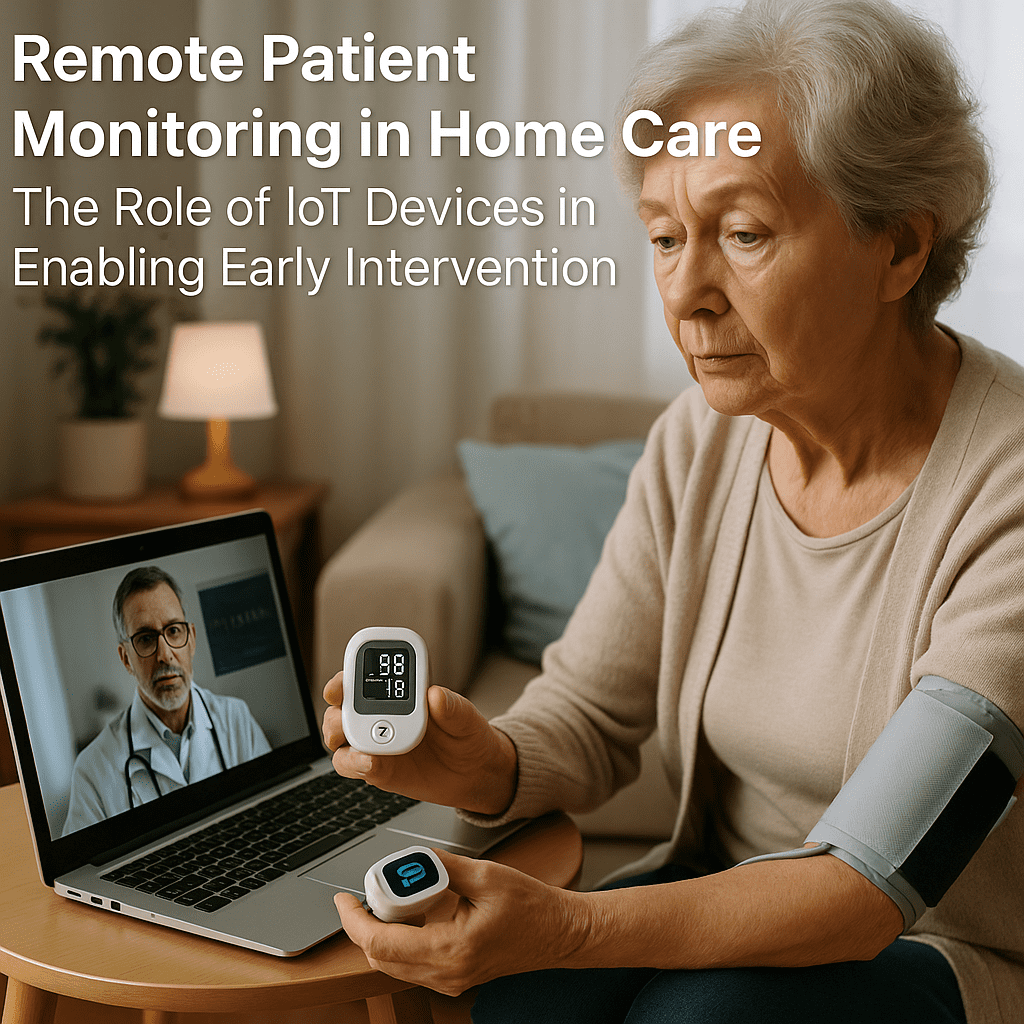
This is where Remote Patient Monitoring, or RPM, powered by the Internet of Things (IoT), comes in. Think of a blood pressure cuff that shares your numbers with your doctor, or a smart inhaler that warns of trouble before you even feel it. The power of IoT in home care is early action, fewer hospital visits, and a life that feels more manageable.
The Rise of Remote Patient Monitoring in 2025
In 2025, RPM moved from being an experiment to something health systems cannot live without. Here’s why:
– The global RPM market grew past 17 billion dollars, a 20 percent jump from 2024.
– There are now over 800 million people worldwide over the age of 65, many with long-term health needs.
– The World Health Organization says we may face a shortfall of 15 million health workers by 2030. RPM helps fill this gap.
– The Centers for Medicare & Medicaid Services expanded payment for RPM in January 2025, and private insurers quickly followed.
Today, RPM is no longer a luxury but a must-have tool for home care teams, hospitals, insurance companies, and even drug makers.
How IoT Powers Early Intervention in Home Care
IoT devices are smart because they help catch problems early. They do this in several ways:
1. Continuous data streams. Instead of just yearly checkups, devices collect round-the-clock numbers like oxygen levels, heart rhythm, and blood sugar.
2. Smart alerts. Algorithms notice small changes that can mean big risks. For example, a 2 to 3 pound overnight weight gain in a heart failure patient may mean fluid overload, and an alert can go out before it’s dangerous.
3. Easier record keeping. In 2025, more IoT vendors use FHIR standards, so data slides into electronic health records smoothly instead of being stuck in separate apps.
4. Smarter triage. With machine learning, doctors and nurses know which patients need fast attention. Hospitals report up to 30 percent fewer unneeded calls by nurses.
This means better timing and better care. Yes, it may feel strange that your doctor knows trouble is coming before you do, but it can also be life-saving.
Key IoT Devices in 2025
The gadgets are the stars of RPM. In 2025, tools are more advanced, reliable, and even stylish. Here are some making a difference:
– Smart blood pressure cuffs
– Continuous glucose monitors for diabetes
– Wearable ECG patches for heart monitoring
– Smart inhalers for asthma and COPD
– Remote pulse oximeters
– Smart thermometers with fever tracking
– Connected weight scales for heart patients
– Fall detection sensors in watches and floors
– Smart pillboxes that track medicine use
– Sleep monitors that pick up apnea events
– Multipurpose wearables that track many signals at once
It’s like a home health toolbox, ready to catch problems before they grow serious.
Clinical Benefits of IoT in Early Intervention
So, does RPM actually work for patients? Research shows it does:
– Hospital readmissions drop by 27 to 35 percent for heart failure patients.
– COPD patients using IoT tools had up to 40 percent fewer emergency trips.
– Patients stay more engaged. Many say they like seeing charts of their progress, which encourages them to stick with care plans.
– RPM helps across several conditions, including diabetes, high blood pressure, recovery after heart surgery, and cancer.
– Health plans save money too, with programs showing $250 to $400 saved per patient per month.
The wins are clear: healthier patients, fewer emergencies, and lower costs.
Challenges and Policy Issues
Of course, RPM is not a quick fix. It brings challenges:
1. Data safety. Hackers target health data, and in early 2025, ransomware attacks took aim at connected medical devices.
2. The digital divide. Not everyone has fast internet or tech skills, especially some seniors and rural patients.
3. Confusing payments. Even with new CMS rules, doctors and billing teams still struggle to sort out RPM, RTM, and telehealth codes.
4. Alert fatigue. Too many warnings at once can overwhelm nurses and doctors, so hospitals are adding smarter filters.
5. Interoperability. Not all companies share data well, which creates extra headaches.
These challenges remind us that design, policy, and support systems are just as important as the devices.
Real-World Use Cases in 2024–2025
Real-world programs prove that RPM works:
– Cleveland Clinic tracked 650 heart failure patients with devices and cut hospital readmissions by 32 percent.
– Kaiser Permanente gave continuous glucose monitors to more than 50,000 people with type 2 diabetes, lowering average A1C scores by nearly one full point.
– Hospital-at-Home programs at Mayo Clinic and Mount Sinai reduced costs by 25 percent using monitoring kits for stable patients.
– Veterans Affairs found RPM reduced psychiatric emergency visits by over 20 percent among rural veterans.
– Accountable care groups found RPM supported their goals in Medicare savings programs.
When both health and cost improve, adoption spreads quickly.
Future Outlook for Home Care
What’s coming next? We can already see some trends:
– Generative AI tools will explain device data to patients in plain language, acting like voice assistants for health.
– Edge computing in wearables will allow faster responses and protect privacy by processing data on the device instead of the cloud.
– Smart homes will act like health hubs, with sensors in beds, bathrooms, and kitchens quietly tracking health without extra effort from patients.
As these grow, RPM will feel less like someone “watching you” and more like your home itself quietly keeping you well.
Closing Thoughts
Remote Patient Monitoring in 2025 shows a new way forward for care. IoT devices give doctors and patients early warnings, cut hospital visits, and save money. The technology is far from perfect, but progress is steady, and the momentum is huge.
The movement is clear: health care at home, supported by smart, connected devices, is not a fad. It is the future. And that future is already here.