How AI-Powered Remote Monitoring Is Improving Chronic Disease Management in Australian Home Care
By SMPLSINNOVATION — where clever tech meets caring hearts.
Introduction
Imagine if your watch could tell your nurse something was wrong before you even noticed. That’s the kind of world we live in today. Australia, famous for beaches and barbecues, is also facing a big challenge: chronic diseases. The Australian Institute of Health and Welfare (2024) says that conditions like diabetes, heart disease, and lung problems are still the top causes of illness, disability, and high medical costs.
Our hospitals are getting crowded, and many nurses and doctors are stretched thin. With more people growing older, we need smart home care that helps people stay healthy without always going to hospital. That’s where AI-powered remote monitoring comes in. This technology doesn’t just track health—it learns, predicts, and helps people stay well at home.
1. The State of Chronic Disease Management in Australia
Right now, about half of Australians have at least one chronic condition, costing more than $80 billion a year. Long wait times, travel distance, and unfair access to care are ongoing problems, especially for people in rural and Indigenous communities.
Old-style healthcare is mostly reactive—patients go for check-ups or to hospital when things get worse. That often means health problems are found too late. But with new national plans, such as the Primary Health Care 10‑Year Plan (2024), Australia is working to bring more care into the home and make digital tools part of everyday health. We’re moving from “see you when it’s bad” to “let’s stop it before it starts.”
2. What Is AI‑Powered Remote Monitoring?
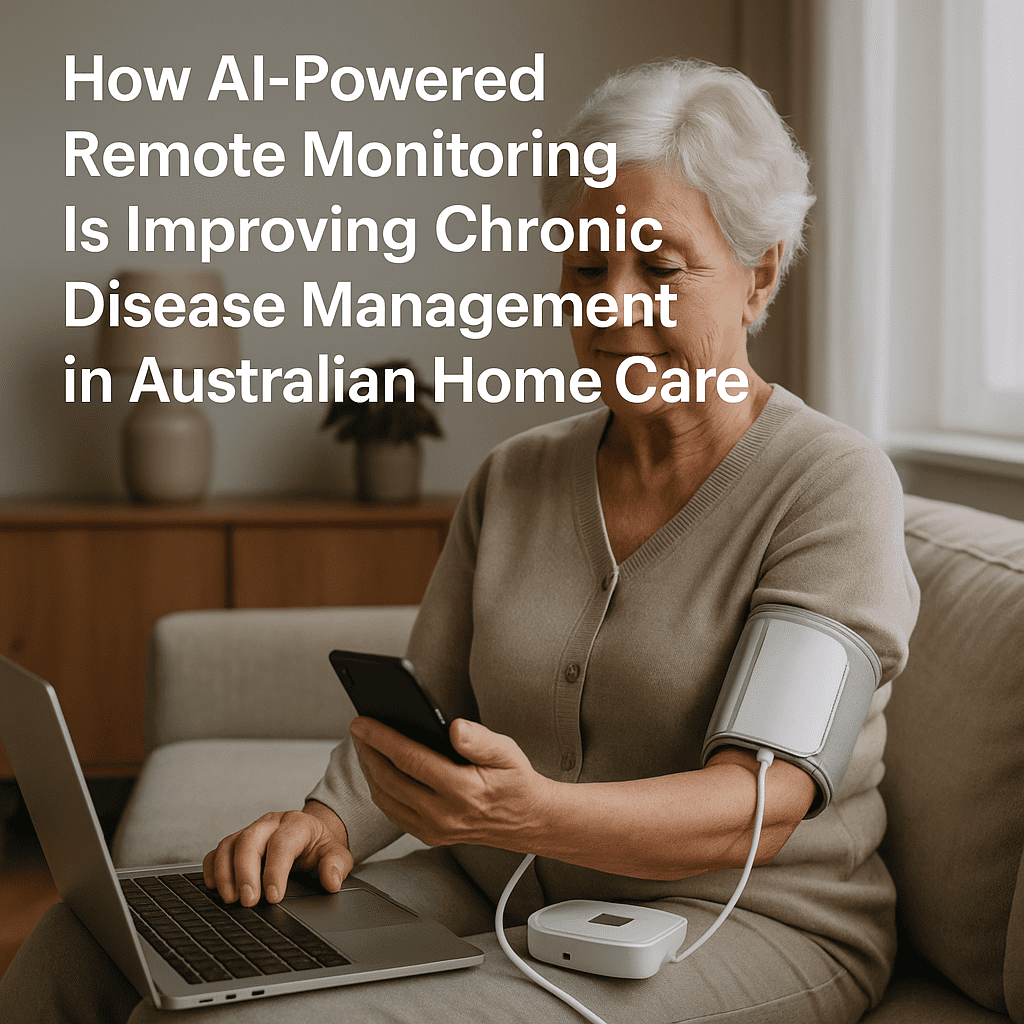
Remote Patient Monitoring, or RPM, means tracking someone’s health at home using smart devices that measure things like heart rate, blood pressure, and oxygen levels. When AI comes into play, these systems can spot early warning signs, learn from patterns, and even predict when someone might get worse before they actually do.
That means it’s not just a gadget—it becomes like a digital health coach that helps both patients and their care teams.
In Australia, common tools include:
• Wearable sensors that send real‑time data to doctors.
• Tablets that collect and share information on easy‑to‑read dashboards.
• Machine‑learning programs built into national health systems like My Health Record.
Together, these systems connect people at home with nurses and doctors, helping everyone make better choices sooner.
3. How AI Is Helping with Chronic Disease Management
3.1 Making Care More Personal and Proactive
Instead of filling the fridge with paper reminders, people now have devices that learn about their health. AI systems can spot small changes in heart or lung conditions, send alerts when something looks risky, and connect straight to telehealth services so doctors can adjust treatment quickly.
This turns patients into active partners in their own care. Seeing their own progress helps people stay motivated and make healthier choices.
3.2 Reducing Hospital Readmissions
Each time AI catches a problem early, it can prevent a hospital visit. CSIRO studies in 2024 showed that AI monitoring for lung disease helped health teams step in sooner, which meant fewer people had to go back to hospital. Smart systems also help nurses focus on patients who need help the most instead of chasing false alarms.
3.3 Improving Access and Fairness
AI technology helps people everywhere, not just those in big cities. For rural Australians who live far from specialists, AI‑guided monitoring allows better care without long travel times. The National Digital Health Strategy (2024) includes plans to make sure everyone, including Indigenous communities, has access to digital care tools.
Government support for smart wearables also makes this care more affordable. Everyone deserves equal access to good healthcare, and AI helps make that possible.
4. Real‑World Examples of AI in Australian Home Care
Here are some ways AI is already being used across Australia:
1. Smart glucose monitors that suggest insulin adjustments.
2. Virtual rehab programs for heart patients using machine learning.
3. Predictive tools for lung conditions that warn days before oxygen drops.
4. Voice assistants that remind patients to take medicine.
5. AI cameras that can tell the difference between a pet jumping and an elderly person falling.
6. Wound care apps that use phone photos and AI for healing checks.
7. Smart blood pressure monitors that share readings with doctors.
8. Food tracking apps that use AI for healthy meal advice.
9. AI systems that track sleep quality to manage sleep and heart problems.
10. Dashboards that help nurses see which patients need the most attention.
11. AI chatbots that check in on mental health each day.
These tools don’t just store data—they turn it into real health improvements for real people.
5. Challenges and Things to Think About
As great as AI sounds, there are still challenges to work through:
1. Protecting data—people need to know their personal health info is safe.
2. Helping older adults learn how to use new devices.
3. Setting up fair funding so everyone can get access to home monitoring.
4. Making sure different systems and devices can share data properly.
5. Ensuring AI is fair and transparent, without bias.
The good news is that all of these can be solved through careful planning, teamwork, and innovation.
6. What’s Next for AI in Home Care
AI in home care is growing fast. In the next few years, we’ll likely see:
• Smarter connections between diagnostic tools and virtual care systems.
• More government programs to provide devices for people who need them most.
• Better health data training for both healthcare workers and patients.
At SMPLSINNOVATION, we’re helping healthcare teams use AI safely and wisely. We believe in building health systems that are smarter, simpler, and kinder for everyone.
Conclusion
AI has gone from science fiction to real life. It’s turning remote monitoring into a friendly dialogue between patients, caregivers, and devices. With AI, managing chronic diseases becomes more personal, predictive, and fair.
Behind every new sensor and algorithm is one big idea: healthcare doesn’t have to happen only in a hospital—it can happen right at home.