Remote Monitoring in Home Care: The Role of IoT Devices in Early Detection of Health Problems
Date: May 16, 2024
By: SMPLSINNOVATION
I. Introduction
If your smartwatch reminds you to keep moving every day, you’ve already seen a small part of the future of healthcare. The Internet of Things, or IoT, is changing how people stay healthy at home faster than ever before.
The World Health Organization says that more than 60% of countries are adding remote patient monitoring to their health plans. Forbes Health reports that the use of smart health devices has gone up by 40% in the last two years. McKinsey Digital predicts that spending on health IoT could reach over 180 billion dollars by 2025. That’s a lot of smart watches and connected medical tools!
Still, home care faces real challenges like managing long-term illnesses, supporting older adults, and giving proper care without overwhelming family members or nurses. This is where IoT-based remote monitoring helps. By using sensors, data analysis, and cloud technology, it keeps doctors informed and patients safer.
In this blog, we will talk about
– What’s happening in home health care right now
– How IoT devices are changing monitoring at home
– How these tools help spot health problems early
– The challenges with data and privacy
– The benefits for patients, doctors, and the economy
Welcome to the exciting world of home health technology, where smart ideas meet kindness, and even your fridge might care about your health.
II. The Current State of Home Care and Remote Monitoring
Home care is where comfort and technology come together.
1. After 2020, home healthcare grew by about 25%, and remote patient monitoring became normal for people with long-term conditions.
2. Older adults, people with illnesses like diabetes or heart disease, and those recovering from surgery need this care the most. Studies show that 85% of seniors want to live at home as they age, as long as they can be safely monitored.
3. In 2024, Medicare and Medicaid made new rules that let doctors get paid for more kinds of remote monitoring. This made remote care a regular service, not just an experiment.
Home care and remote monitoring are now important parts of modern healthcare.
III. How IoT Devices Are Changing Home Health Monitoring
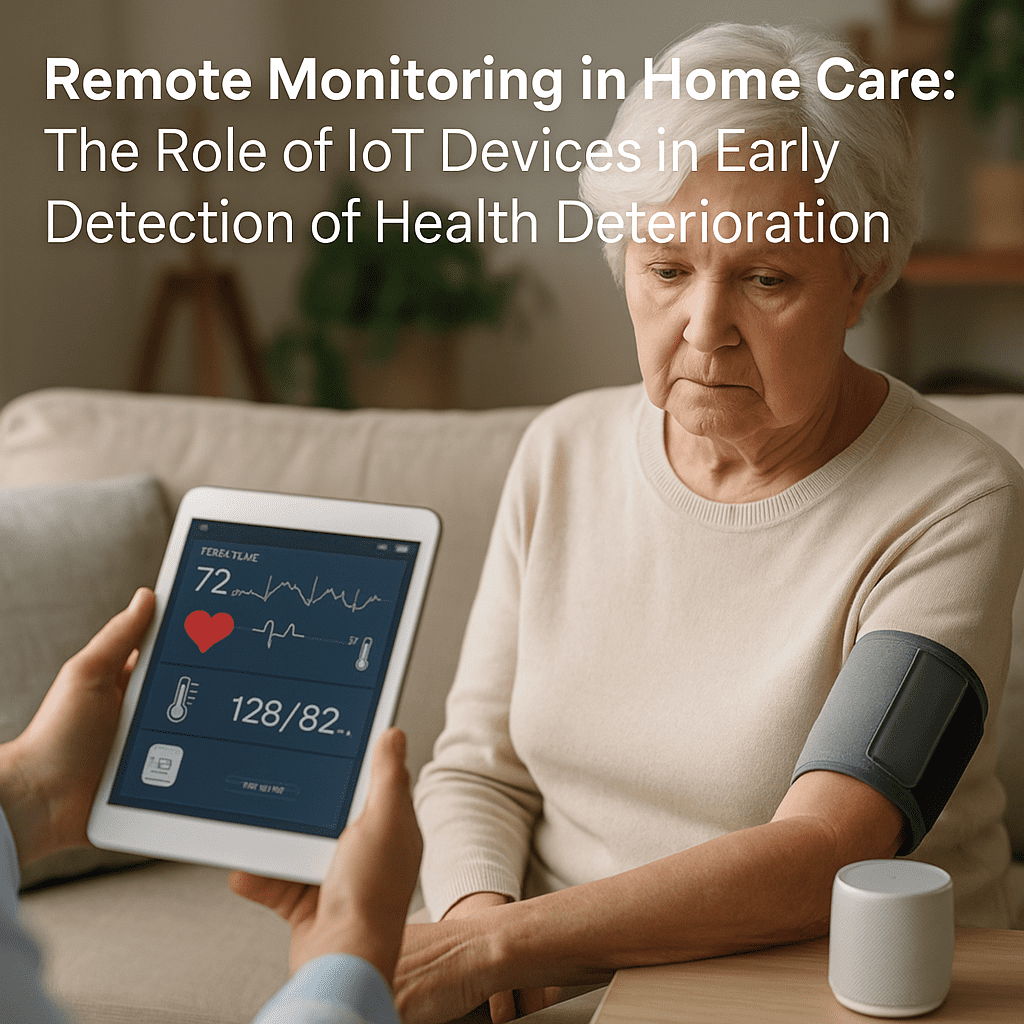
IoT in healthcare may sound like science fiction, but it’s actually quite simple. It’s a group of smart devices that collect health information, send it to the cloud, and share results in real time. You can think of it as having 24/7 tech support for your body.
Here are the top IoT devices used in home care in 2024:
1. Wearable heart and ECG monitors that check heart rhythms
2. Smart blood pressure cuffs that share readings with doctors
3. Continuous glucose monitors for people with diabetes
4. Smart inhalers that remind patients to take their medicine
5. Fall detection sensors that alert caregivers when someone falls
6. Smart thermometers that help track temperature changes
7. Smart pill dispensers that prevent missed or double doses
8. Connected pulse oximeters that measure oxygen levels
9. Sleep monitors that detect problems like sleep apnea
10. Smart scales that track weight and hydration
With extra sensors that track movement, lighting, and air quality, home care is becoming a connected, helpful system instead of a lonely one.
IV. Early Detection: How IoT Helps Find Health Problems Sooner
There’s a saying that “prevention is better than cure,” and IoT makes that possible. These smart devices collect information about heart rate, blood sugar, blood pressure, oxygen level, and movement. The information goes to the cloud, where computer programs look for unusual patterns that could mean a problem. Doctors can then act before it turns serious.
Three main ways IoT helps with early detection are:
1. Spotting unusual changes in vital signs by noticing what’s normal for each person and what’s not
2. Using artificial intelligence to predict risks, like hospital readmission or infections
3. Sending real-time reports to doctors through digital records so they can give early help
It’s like having a friendly digital guardian always watching out for your health.
V. Data Reliability, Privacy, and Compatibility Challenges
Even though IoT is helpful, it comes with challenges. A 2024 report highlights three main issues:
1. Devices from different makers sometimes use different data formats that don’t work well together.
2. Sharing health data between homes, clinics, and cloud systems must follow privacy laws, so patients must give clear permission.
3. Too many alerts from devices can tire out doctors and caregivers, making it harder to spot real emergencies.
New solutions are being developed, like blockchain systems that keep data records safe, smart filters that separate false alarms from real warnings, and shared software systems that let different devices work together safely.
At SMPLSINNOVATION, we are helping healthcare groups build trust and safety into these systems.
VI. Clinical and Economic Benefits of IoT-Based Monitoring
IoT-based remote monitoring brings big benefits for both health and costs.
Clinical benefits:
1. Fewer hospital visits for people with chronic diseases
2. Better medicine use because reminders keep patients on track
3. Earlier detection of health problems, often days before symptoms appear
4. Stronger patient involvement thanks to user-friendly apps
5. Easier access to specialists without travel
Economic benefits:
1. Lower overall healthcare costs by reducing hospital visits
2. Less need for in-person checkups, which saves time
3. More ways for providers to get paid for remote care
4. Long-term cost savings through prevention and management
5. The ability for small teams to safely care for more people
Everyone wins—especially patients who get to stay comfortable at home.
VII. The Future of IoT and Home Care
By 2025, we can expect even more growth in this area:
1. Smarter AI systems that can predict problems with better accuracy
2. New kinds of sensors, like painless glucose monitors and smart tattoos
3. A mix of virtual and in-person checkups
4. Faster data speeds from 5G networks that make real-time monitoring smoother
Home care is becoming smarter, safer, and more personal each year. With IoT, the future of staying healthy at home looks bright.