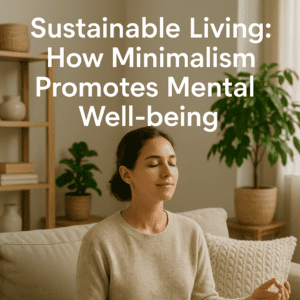
Sustainable Living: How Minimalism Promotes Mental Well-being
By SMPLSINNOVATION
I. Introduction
Have you ever looked around your house or your phone and thought, “When did I collect so much stuff?” You are definitely not alone. All over the world, people are realizing that buying more things doesn’t always make life better. In fact, it can make life feel more stressful.
Minimalism used to be something you saw only in art or design magazines, but now it’s become a way of living. More people are learning that having a clean space and fewer things can help both the planet and their own peace of mind.
Recent reports from Harvard Health Publishing and Psychology Today show that reducing what we own can also calm our minds. Living with less isn’t about being strict or boring—it’s about making room for what truly matters.
At SMPLSINNOVATION, we care about healthy systems—for people and for technology. Today, we’ll explore how minimalism can be like a healthy “update” for your mind and the planet.
II. The Modern Context: Why Minimalism Matters Now
The world today is full of noise. It’s not just traffic or phone alerts—it’s ads, social media posts, and constant buying options. A recent Harvard Health study found that many young people feel stressed trying to balance caring for the planet while living in a fast digital world.
Psychology Today shared that too many choices can make our brains feel tired. Most of us try to handle dozens of open tabs, endless shows to stream, and the constant pull to “Buy Now.” Our minds were not built for that kind of overload.
Since the pandemic, many people have started to simplify their lives. They want less clutter and more calm. This shift toward minimalism is not a passing trend—it’s a way to feel lighter, both mentally and emotionally.
Minimalism also works online. Fewer apps, a tidy inbox, and unsubscribing from old emails can make a big difference. These small steps toward simplicity are becoming the new kind of luxury.
III. How Minimalism Supports Mental Health
Why does owning less make us feel better? It’s about space—both around us and inside us. Studies from Forbes Sustainability and Harvard Health suggest that minimalism helps mental health in many ways:
1. A clean space makes your brain feel safe and relaxed.
2. Fewer possessions mean less fear of losing things.
3. Less clutter makes it easier to manage your emotions.
4. A calm room helps you sleep better.
5. Fewer distractions mean better focus.
6. Having less helps you appreciate what you already have.
7. You value experiences and relationships more than things.
8. You feel more in control of your choices.
9. You stop comparing yourself to others online.
10. Spending less money creates peace of mind.
When our surroundings are simple, our thoughts can be simple too. Clearing clutter helps clear stress, which leads to more focus and joy.
IV. Sustainable Living Through a Minimalist Lens
Minimalism is not just good for you—it’s good for the Earth. The Guardian Environment reported that living simply helps reduce waste and protect nature. Here’s how minimalism helps both people and the planet:
1. Buying less means fewer resources are used.
2. Minimalists often choose products made locally and ethically.
3. Reusing and sharing items saves materials.
4. Smaller homes use less energy.
5. Avoiding fast fashion reduces waste.
6. Fewer gadgets mean lower energy use.
7. Less buying means less trash.
8. Investing in quality products reduces replacement needs.
9. Sharing and swapping builds stronger communities.
10. Choosing mindful living changes culture toward sustainability.
Minimalism helps your mind rest and helps the planet heal. When we live with care, everyone benefits.
V. Practical Ways to Embrace Minimalism for Mental Well-being
Living simply doesn’t mean having empty rooms or no personality. It’s about making space for what’s truly important. Here are ten easy ways to start:
1. Clean one small area at a time. Start with a drawer or closet.
2. Follow the “one in, one out” rule—when something new comes in, something old goes out.
3. Delete unused apps or clean your email inbox.
4. Choose digital content that makes you feel good.
5. Decide what “enough” means for you—how many things you really need.
6. Buy items that last a long time.
7. Spend money on what brings you peace or supports your values.
8. Take breaks from technology to rest your mind.
9. Include family or friends so it’s a team effort.
10. Celebrate your progress, even small steps.
Minimalism can be fun. Turn on some music, play games while cleaning, and enjoy the process of creating space.
VI. Minimalism, Health Tech, and the SMPLSINNOVATION Philosophy
At SMPLSINNOVATION, we believe that simple systems work best. In health technology, simpler designs mean better results. With fewer clicks and cleaner data, we get more helpful and efficient tools. It’s like digital minimalism in action.
We’ve learned that when systems are cluttered, they don’t perform well. The same is true for people. Minimalism helps both humans and technology work smoothly. Our approach is simple:
Less friction, more function.
Less waste, more wellness.
Less noise, more flow.
Everything is connected—people, technology, and the planet all function better when things are clear and simple.
VII. Conclusion
Minimalism is not about living with almost nothing—it’s about having just enough. It teaches us to let go of what doesn’t help us and focus on what does. Studies from Harvard Health, The Guardian, and Forbes all show that living simply helps both mental health and the environment.
Decluttering is like a moving form of mindfulness—it brings order to your space and to your thoughts. At SMPLSINNOVATION, we believe that innovation begins with simplicity. When things are clear, great ideas can grow.
So take a deep breath. Open that old drawer. Start small, and see how it feels. Both your mind and the planet will thank you.