How Virtual Reality is Changing Stroke Rehabilitation in Hospitals
By SMPLSINNOVATION | Health Technology Consulting | February 2024
I. Introduction
If someone told you ten years ago that hospital stroke therapy would one day feel like a video game, you might not have believed it. But today, virtual reality, or VR, is becoming one of the most exciting tools in hospital recovery.
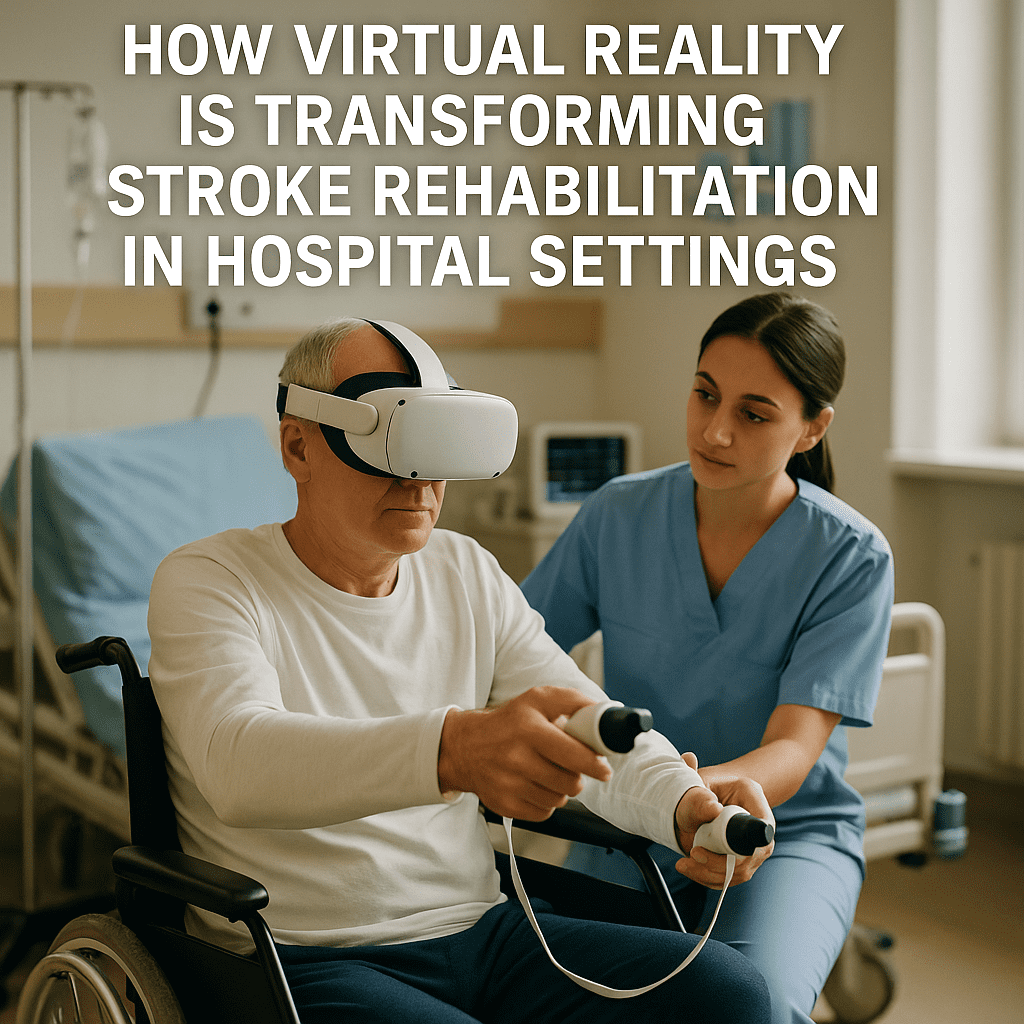
Hospitals around the world are using VR to help stroke survivors regain strength, balance, and confidence. Stroke is one of the main causes of long-term disability, and recovery takes a lot of effort and time. Traditional physical therapy can be boring and tiring.
Now, with virtual reality, patients can practice movement in fun, interactive, and safe environments. It’s not about pretending to be in space—it’s about using science and technology to help people heal faster and stay motivated.
This article explains how VR is changing stroke recovery in hospitals based on new research and case examples published in early 2024.
II. Understanding Stroke Rehabilitation in 2024
Stroke rehabilitation helps people regain movement, thinking skills, and independence after a brain injury. The goal is to help patients return to daily life as much as possible.
Therapy can be tough. Many hospitals have faced similar problems:
1. Patients lose motivation because exercises are often repeated many times.
2. One-on-one therapy can be expensive and time-consuming.
3. Not all patients can see therapists regularly.
4. Progress can be hard to track.
5. Standard exercises don’t fit everyone’s needs.
6. Patients often feel tired or discouraged.
7. Therapists from different areas sometimes don’t work closely together.
8. Therapy isn’t always fun.
9. People in rural areas may not get enough care.
10. Once patients leave the hospital, they may stop doing their exercises.
That’s why hospitals are looking for new ways to make therapy more personal, interesting, and data-based. VR, together with artificial intelligence and sensors, helps create a clearer picture of each patient’s progress.
III. The Science Behind VR in Rehabilitation
How does VR help with stroke recovery? Behind those headsets is some amazing science.
1. Repeating VR exercises helps the brain build new connections, a process called neuroplasticity.
2. Sensors give instant feedback so patients can fix their movements.
3. Patients can safely practice real-life tasks like cooking or walking up stairs.
4. The games in VR environments make therapy more fun and rewarding.
5. The senses—like sight, balance, and body awareness—work together to improve recovery.
6. The system can make exercises harder as patients improve.
7. Both the brain and body are trained at the same time.
8. Each program changes based on the patient’s needs.
9. Patients feel more confident as they reach clear goals.
10. Group VR sessions help create community support.
Recent studies from early 2024 show strong proof that VR works. Patients using VR therapy improved motor function by about 25 percent more than those using standard therapy. They also showed higher engagement and better long-term quality of life.
IV. How Hospitals Are Using VR
More hospitals are adding VR to stroke recovery programs:
1. Patients use VR to rebuild arm and hand coordination by grabbing virtual objects or painting in the air.
2. Memory and puzzle games help rebuild thinking skills.
3. Virtual balance challenges help patients walk more steadily.
4. VR can reduce pain by distracting the mind.
5. Therapists can monitor patients’ movements through online dashboards.
6. VR programs can be adjusted to each patient’s strength and energy level.
7. Movement data is recorded automatically to track progress.
8. Patients can join group therapy in shared VR spaces for motivation.
9. Real-life activities, like getting dressed or eating, can be practiced safely.
10. Even after leaving the hospital, patients can continue VR therapy from home with remote support.
This makes hospital rehab feel more like a cooperative game—where progress is measured not just in points, but in personal recovery.
V. Real-World Examples
Hospitals across the globe are already seeing success:
– In the United States, the Mayo Clinic uses VR therapy that has led to shorter, more engaging sessions. Cedars-Sinai uses VR that connects digital activities to real-life movement.
– In Europe, the UK’s NHS and the EU’s REHAB-VR Project have integrated VR programs across hospitals.
– In Asia, Singapore General Hospital reduced rehab time by 30 percent using VR. Seoul National University Hospital uses it for younger stroke survivors.
– In Australia, the Royal Melbourne Hospital improved hand strength with VR gloves.
– In the Middle East, Cleveland Clinic Abu Dhabi developed Arabic-language VR programs for local patients.
Together, these hospitals reported faster recovery, fewer readmissions, happier patients, and more efficient therapy systems.
VI. Benefits for Patients and Clinicians
Both patients and doctors are excited about the results:
1. The visuals and games keep patients motivated.
2. Doctors get accurate data instantly.
3. Automation helps therapists save time on paperwork.
4. Patients recover faster and spend less time in the hospital.
5. VR adjusts exercises for each person’s progress.
6. Communication between therapists is easier.
7. The same system can serve many patients.
8. Safety improves since the environment is controlled.
9. Data helps improve therapy results over time.
10. Patients feel proud seeing their progress.
Many patients say VR therapy is the first exercise they actually enjoy doing.
VII. The Future
The journey doesn’t stop here. Future hospital systems will likely use artificial intelligence to design even smarter therapy programs. VR will also connect hospitals and homes so patients can keep improving after discharge.
With new technology like brain sensors and improved data tracking, stroke recovery will become more personalized, faster, and more hopeful than ever before.
Virtual reality is no longer just a game—it’s becoming one of the most powerful tools in modern hospital care.