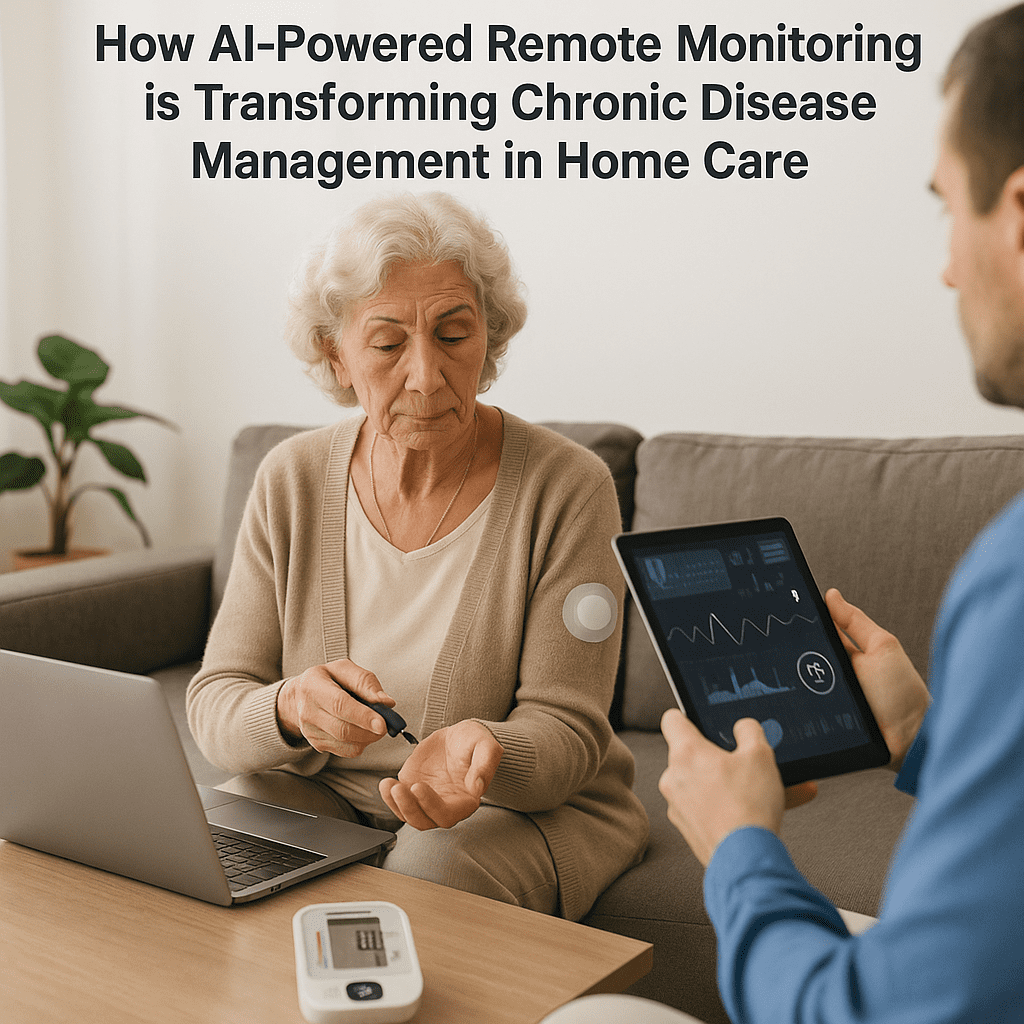
How AI-Powered Remote Monitoring is Changing Chronic Disease Care at Home
By SMPLSINNOVATION | Published February 2025
I. Introduction
If your smartwatch has reminded you to stand up several times today, you are already part of the new world of healthcare. Chronic diseases like diabetes, heart failure, and high blood pressure are some of the biggest health challenges today. The World Health Organization (2024) says that these diseases cause more than 70% of deaths around the world and take up a large part of healthcare spending.
More people now receive care at home because technology makes it possible. But old-style home care—using paper logs, nurse visits, and phone check-ins—can’t keep up with fast changes in a patient’s health. Symptoms can worsen without anyone noticing, and help may come too late.
That’s where AI-powered remote monitoring comes in. With tools like machine learning and cloud systems, healthcare teams can spot problems early and act on them. This means care is continuous, personal, and based on real data. In short, our homes are becoming smarter and safer places for health care.
II. The Current State of Chronic Disease Care at Home
1. The Global Picture
Chronic diseases affect people everywhere:
– Diabetes now impacts more than 530 million adults.
– Heart failure hospitalizations rose by 23% between 2019 and 2024.
– Chronic lung disease remains a top cause of death.
– High blood pressure affects about 1.28 billion adults, many without knowing it.
These numbers show how many people must manage medicines, doctor visits, and lifestyle changes while trying to live normal lives.
2. The Challenges
Home care is helpful but not always easy. People face three main problems:
1. Delayed Detection: Many don’t realize early warning signs until things get worse.
2. Hard to Stay on Track: It takes a lot of discipline to record daily readings like blood pressure or sugar levels.
3. Disconnected Data: Health data often stays in separate systems, making teamwork harder for doctors and caregivers.
3. Policy Progress
Governments are starting to catch up:
– In the United States, Medicare and Medicaid now support reimbursement for remote monitoring.
– The European Union passed the Digital Health Act to make telemedicine more connected.
– The WHO’s Digital Health Strategy asks countries to include AI monitoring in home care plans.
It’s clear that the future of chronic disease care will be home-based and powered by AI.
III. The Role of Artificial Intelligence in Remote Monitoring
AI-powered remote monitoring doesn’t replace doctors. Instead, it helps them make sense of patient data faster and more accurately.
1. The Basics
These systems use a few key tools:
– Sensors to check heart rate, oxygen, or activity levels.
– Cloud computing to safely store and share data in real time.
– Machine learning to recognize patterns and predict problems.
2. How AI Helps
– Predictive Modeling: AI uses past data to guess who might need extra care soon.
– Language Processing: AI can read doctor notes or patient messages to pick up small signs of change.
– Computer Vision: Cameras can safely track movement or posture to detect physical changes.
3. Smart Devices Working Together
Your watch, scale, and glucose monitor can all send data to one system. AI studies that data and gives friendly advice such as, “Take it easy today, your heart rate looks high.” The result is care that’s fast, connected, and personal.
IV. Ten Ways AI is Changing Chronic Disease Care
1. Detecting early warning signs before patients feel sick.
2. Creating care plans that fit each person’s daily habits.
3. Predicting who might need hospital care and acting early.
4. Tracking if patients take their medicines on time.
5. Suggesting adjustments to keep blood sugar steady.
6. Watching heart rhythms for irregular patterns.
7. Analyzing voice or breathing to predict lung problems.
8. Sorting data for doctors so they focus on real risks.
9. Spotting mood or sleep changes that affect mental health.
10. Supporting policy makers with overall health data.
This shift means we no longer wait for sickness to strike—we can prevent it instead.
V. Real-Life Examples and New Ideas (2024–2025)
1. The Mayo Clinic and IBM built a system that predicts heart failure readmissions with 85% accuracy.
2. Philips and Microsoft’s Azure AI help patients with breathing problems, cutting emergency visits by 30%.
3. Livongo and Dexcom combined tools for diabetes care, linking food records and glucose levels.
4. In the UK, more than 100,000 patients get home care supported by AI alerts through the NHS Virtual Ward.
5. The WHO leads projects in India and Brazil using smartphones to spot lung disease early.
These examples show AI doesn’t replace doctors but gives them better tools to care for patients.
VI. Challenges and Ethics
AI in healthcare faces a few key issues:
1. Keeping patient data private and safe.
2. Making sure algorithms are fair for all people.
3. Fitting new systems into hospital workflows without adding stress.
4. Helping patients who aren’t tech-savvy understand the tools.
5. Creating clear rules and standards for global use.
At SMPLSINNOVATION, we believe in building ethical, open, and patient-friendly AI tools so everyone feels supported and safe.
VII. The Road Ahead
What’s coming next:
– AI will combine data from wearables, homes, and even genetics.
– Voice-based tools will listen for breathing or memory changes.
– Generative AI will help doctors by writing patient summaries.
– Devices will work together more easily through new standards.
– Insurance programs will pay for more remote AI-based care.
The coming years will bring smarter, more connected home care for everyone.
VIII. Conclusion
AI-powered remote monitoring is already changing how we manage chronic diseases at home. It helps people stay healthier, gives doctors better insight, and keeps care closer to where life happens—right in our living rooms. The future of healthcare is not in the hospital; it’s wherever you are.