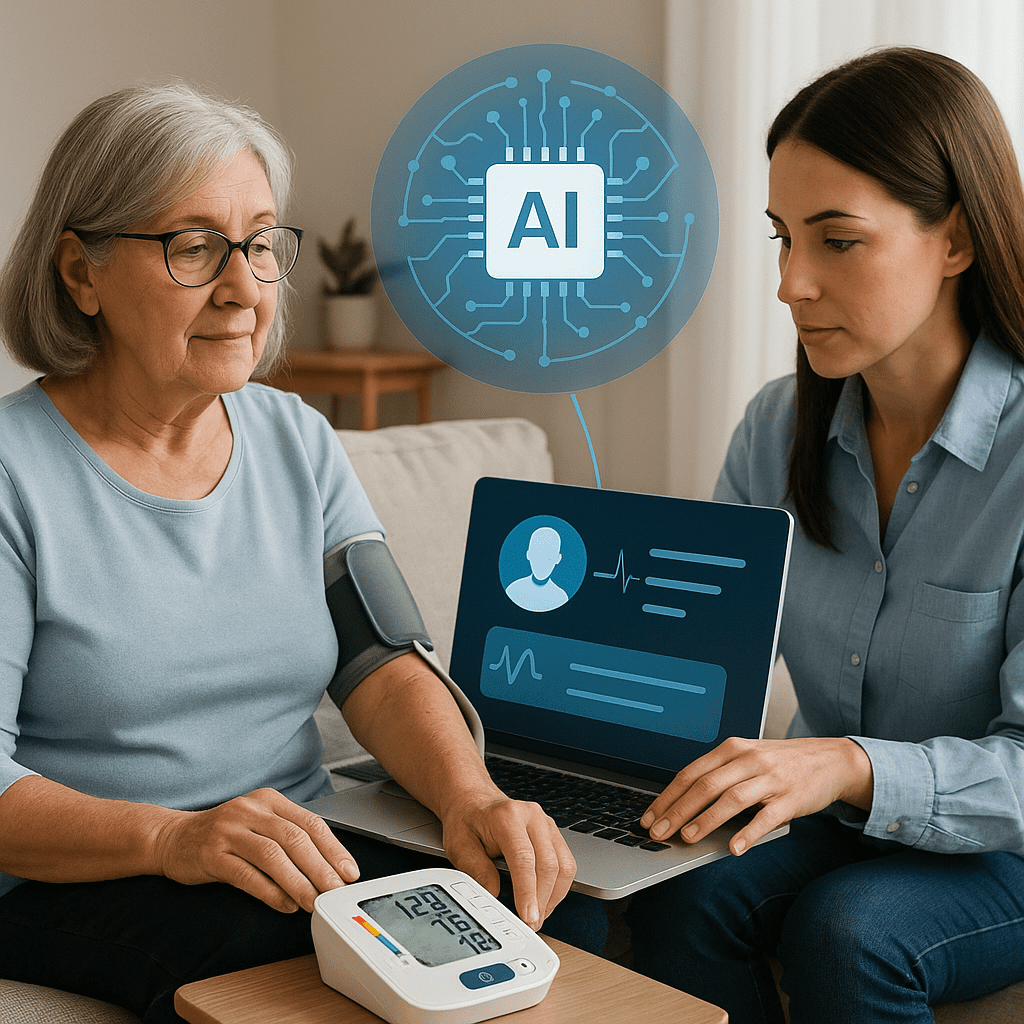
How AI-Powered Remote Monitoring Is Improving Chronic Disease Management in Home Care
By SMPLSINNOVATION | February 2025
I. Introduction
Chronic diseases are long-term health problems that never seem to go away. They make up more than 70% of global healthcare costs and affect about one in three adults around the world. Conditions like diabetes, heart failure, and COPD are not only tough to manage but also stressful for patients, caregivers, and the entire healthcare system.
Luckily, healthcare is changing. More people are getting care at home instead of always visiting hospitals and clinics. This new way of care is built around value-based care models, patient-centered design, and the power of Artificial Intelligence, or AI.
AI-powered remote monitoring systems are now changing how chronic diseases are managed at home. By using smart sensors, machine learning, and predictive tools, doctors and nurses can see small health changes before they become big problems. It’s like having a medical crystal ball that uses math and data instead of magic.
II. The Core Technologies Behind AI-Powered Remote Monitoring
AI is part of a larger connected system that depends on good technology and internet access.
1. Artificial Intelligence and Machine Learning
– Predictive programs can find early warning signs by studying heart rate, glucose levels, or other data before a crisis happens.
– Natural Language Processing helps computers read and understand messages or notes from patients and doctors, so nothing important is missed.
– Reinforcement learning helps create flexible care plans by adjusting medicine or exercise routines to fit a patient’s daily habits.
2. Internet of Medical Things (IoMT) Integration
– Smart wearables check things like blood pressure, glucose, and oxygen all day and night.
– Connected home devices such as smart scales or glucose monitors send information safely to doctors.
– Cloud dashboards let healthcare teams watch over many patients in real time so they can act quickly if something changes.
3. Predictive Analytics and Digital Twins
– Digital twins are virtual copies of patients that help predict how someone’s health might change.
– Electronic health records connect past medical information with new data from sensors for better treatment decisions.
– Early alert systems can spot small signs of health trouble, such as breathing changes or drops in activity.
Together, these tools turn health data into actions that help people stay well at home.
III. How AI-Powered Monitoring Is Changing Chronic Disease Management
These are some of the main ways AI-powered monitoring is improving care right now.
1. AI identifies health problems early, often before symptoms appear.
2. Care is more personal since algorithms adjust medicines, food, and exercise plans for each person.
3. Sensors remind patients to take their medicine and stay on track.
4. Alerts help doctors act early to prevent hospital visits.
5. Hospitals can better focus on the most urgent patients.
6. AI chatbots give patients friendly health tips and support 24/7.
7. AI watches medical devices to make sure they are working correctly.
8. Data from video, text, and sensors helps doctors see the full picture.
9. Caregivers and families can securely view updates and worry less.
10. Public health experts use AI data to find patterns and stop future problems.
These improvements lead to fewer hospital trips, better outcomes, and a stronger healthcare system overall.
IV. Real Stories and Proof From 2024–2025
Several research studies have already shown how AI-powered home monitoring makes a big difference.
1. Mayo Clinic’s heart failure program reduced hospital readmissions by 35% with AI that spotted fluid buildup five days early.
2. Philips and Microsoft’s diabetes project used wearables and cloud analytics to improve blood sugar control by 22%.
3. Kaiser Permanente’s COPD program reduced serious flare-ups and hospital admissions by 30%.
4. Cleveland Clinic’s AI for high blood pressure helped doctors find the best medicine mixes, lowering uncontrolled BP rates by 18%.
5. The UK’s NHS used digital twins for lung disease management and reduced symptom severity by 10%.
These studies show that AI in home care is real, effective, and ready for everyday use.
V. Challenges and Considerations
Even with its benefits, AI-powered care has some challenges to solve.
1. Data privacy and security: Patients want to know their health data is safe. Strong encryption, secure systems, and clear permissions are essential.
2. Integration barriers: Old hospital software can be hard to connect to new AI systems. It takes effort and teamwork to make everything work well together.
3. Algorithm bias and accuracy: AI is only as fair as the data it learns from. It needs regular updates and diverse data to stay fair and accurate.
4. Workforce training: Nurses, doctors, and IT teams must learn how to use these tools and trust the alerts they see.
5. Rules and ethics: As AI becomes more common, questions about responsibility and regulation need clear answers.
VI. The Future: Smarter and More Human Home Care
AI-powered remote monitoring isn’t just about numbers and charts—it’s about caring in a more personal way.
In the next few years, we can expect:
1. Digital twins for every major chronic disease.
2. Voice-based monitoring that listens for changes in tone, breathing, or emotion.
3. Platforms that combine care for heart, lung, and metabolic conditions in one system.
4. AI helpers for doctors that suggest next steps based on full patient data.
5. Easy-to-use dashboards for patients to see progress and celebrate small wins.
At SMPLSINNOVATION, we work with healthcare providers and technology teams to make these systems real and useful. We help connect devices, design data systems, and train medical teams so care can be simpler and smarter.
VII. Conclusion
Chronic disease care is moving into a new age. By bringing AI, connected devices, and human compassion together, we’re shifting from reacting to problems to preventing them.
The result is fewer hospital stays, happier patients, and a healthcare experience that finally fits modern life.
So the next time your smartwatch buzzes, remember—it’s not bothering you; it’s helping you stay healthy. Thanks to AI-powered remote monitoring, healthcare just got a little more smpl.
Written with a smile by SMPLSINNOVATION, helping healthcare organizations harness the power of intelligent care.