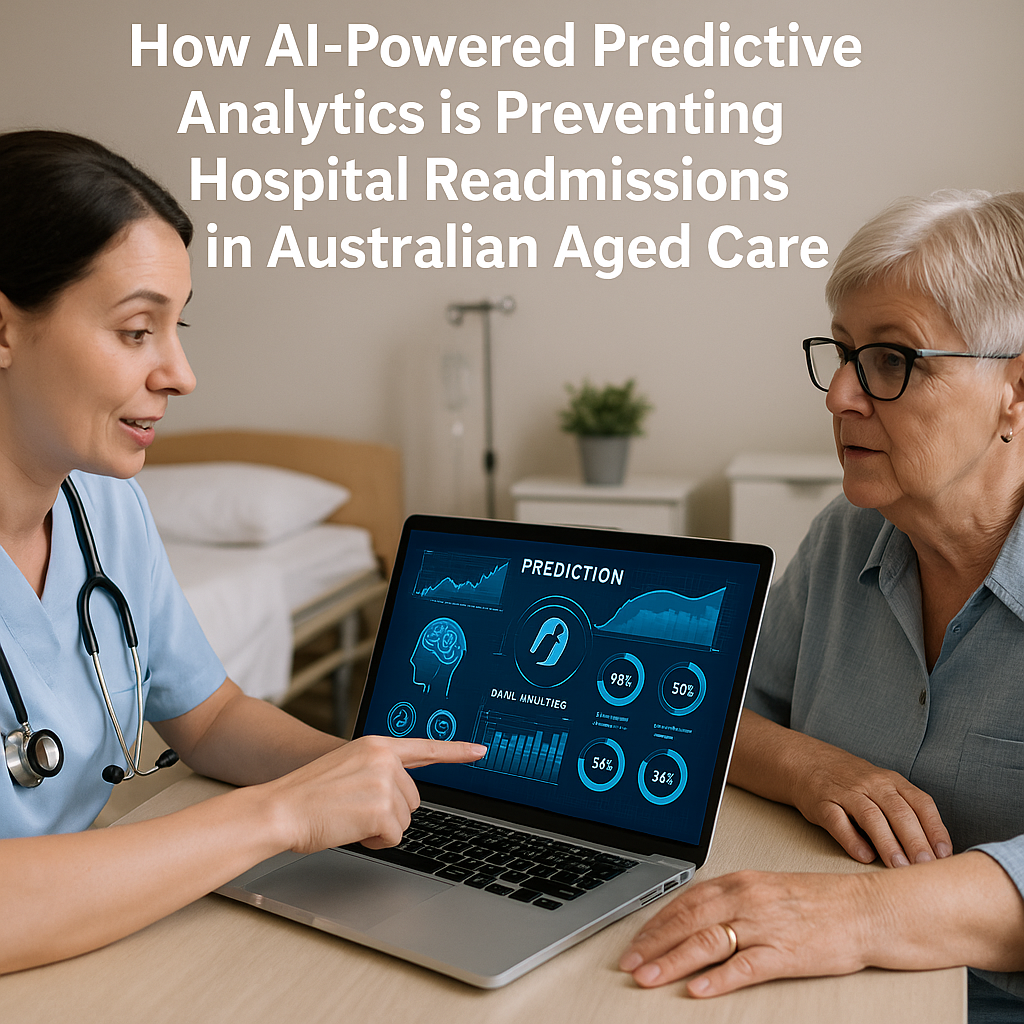
How AI Powered Predictive Analytics is Preventing Hospital Readmissions in Australian Aged Care
By SMPLSINNOVATION | February 2025
1. Introduction
If you need proof that technology can save lives and reduce paperwork at the same time, look no further than Australia’s aged care sector. With more Australians living longer and healthier lives, aged care homes are under extra pressure. The main problem? Hospital readmissions. These “back again?” moments are stressful for residents, carers, and the whole healthcare system.
Readmissions cost hundreds of millions of dollars each year and have a big impact on older Australians’ wellbeing. But in 2025, there’s some good news. AI powered predictive analytics is stepping in to help. It can spot risks early and stop problems before they lead to another trip to the hospital.
In this story, we’ll look at how Australian innovators — from the CSIRO’s Australian e‑Health Research Centre to state health departments and brilliant data scientists at universities — are working together to make aged care both smarter and safer. It’s a story of hope and clever technology.
2. The Current State of Aged Care and Readmissions in Australia
According to the AIHW 2025 report, about 15% of aged care residents sent home from hospital are readmitted within 30 days. Most of these cases are linked to common long‑term conditions like heart failure, COPD, and diabetes. The good news is that with the right data tools, many of them can be prevented.
Right now, there are three main trends shaping aged care:
1. Complex Health Conditions – Older Australians often have more than three health issues, which makes recovery harder.
2. Post‑Discharge Gaps – Once people leave the hospital, their care team often loses real‑time visibility.
3. The Digital Health Push – The Federal Government’s Digital Health Blueprint 2025 wants all aged care providers to start using smarter health data systems, including predictive models.
But there are still challenges:
– Different systems don’t always share data easily between hospitals, doctors, and aged care homes.
– Staff are already busy and have limited time to track residents in detail.
– Some people are hesitant about new technology, especially when it sounds as confusing as teaching Grandma about cryptocurrency.
3. Understanding Predictive Analytics in Healthcare
Predictive analytics uses data and AI to look at patterns from the past to predict what might happen next. In healthcare, that means finding out who is likely to return to the hospital before it happens.
The main parts of predictive analytics are:
1. Machine Learning – Data driven algorithms that learn and get more accurate over time.
2. Natural Language Processing – This turns messy clinical notes into clear information that computers can use.
3. Internet of Medical Things – Smart devices and wearables that constantly collect health data.
The most useful sources of data are:
– Electronic Health Records with details like medical history and discharge notes.
– Wearables that track heart rate, movement, and other signs.
– Medication logs that show if a resident skips a dose.
Privacy and ethics are very important. Australia’s Data Governance Standards and Privacy Principles protect patient information. AI systems must also be designed to avoid bias so that everyone gets fair and equal care.
4. How AI Predicts and Prevents Hospital Readmissions
Think of predictive analytics as a clever assistant that spots small changes and quietly warns, “Something might be wrong.”
Here’s how the process works:
1. Data is collected from hospitals, devices, and digital records.
2. AI assigns a risk score that helps find residents who might need extra help.
3. If someone’s risk rises, the system quickly alerts the care team.
4. Nurses or doctors can check in early through a call, home visit, or telehealth session.
5. The system learns from results and continues to improve its predictions.
This approach works very well for conditions like heart failure, COPD, and diabetes, which cause most unplanned hospital returns for older people.
5. Real World Examples in Australian Aged Care 2025
Here are ten examples of how predictive analytics is already helping aged care in Australia:
1. CSIRO’s PredictDX – Used in 12 aged care homes, predicts readmission risk up to two weeks in advance.
2. NSW Health’s CareAI Trial – Cut 30‑day readmissions in rural areas by 27%.
3. HealthMetrics Analytics Suite – Helps spot dangerous drug interactions in older patients.
4. Monash University’s AgeWell AI Hub – Uses walking and speech patterns to predict frailty.
5. Telstra Health’s PredictCare Platform – Combines wearable and medical record data to spot early trouble with breathing.
6. Queensland Health AI‑MyHealth Pilot – Links hospital and community care data for smoother home recovery.
7. Flinders PredictMed Project – Finds diabetes readmission risks with over 85% accuracy.
8. University of Sydney’s NeuroPredict Study – Uses GP notes to detect signs of cognitive decline early.
9. SilverChain’s SmartCare Initiative – Uses remote monitoring and predictive alerts to reduce emergency callouts.
10. St. Vincent’s Health Predict4Care – Uses an AI dashboard to manage care and prevent readmissions.
These projects show that predictive analytics isn’t just fancy tech. It’s helping older Australians stay healthier and out of hospital.
6. Benefits for Providers and Residents
Everyone benefits when predictive analytics is done right.
For Providers:
– Fewer readmissions and lower costs.
– Staff can work more efficiently with automated alerts.
– Health records are easier to share across teams.
For Residents and Families:
– Peace of mind from consistent monitoring.
– Personalized care that’s based on real data.
– Fewer stressful hospital stays and more time at home.
For the Healthcare System:
– Big cost savings from fewer readmissions.
– Better overall health for older Australians.
– Smarter resource planning for hospitals and governments.
7. Implementation Challenges and Solutions
Like any new technology, predictive analytics has some hurdles. The main ones are:
1. Data Systems Don’t Always Connect – National standards are being developed to fix that.
2. Staff Training – When people understand AI is there to help them, not replace them, adoption goes smoothly.
3. Ethics and Fairness – The Australian Commission on Safety and Quality in Health Care ensures AI decisions are transparent and fair.
Aged care providers are working with ethics experts, data scientists, and advocacy groups to make sure these tools are safe, fair, and human‑focused. After all, technology should always be kind.
8. The Future of Predictive Analytics in Australian Aged Care
The future looks bright. By 2030, predictive analytics will be a normal part of aged care.
Driving this change will be:
1. Faster 5G and smart device connections for smoother remote monitoring.
2. Better data sharing through My Health Record between hospitals and aged care homes.
3. AI co‑pilots that support doctors and nurses with instant health insights.
The CSIRO’s Future of Health Report predicts up to a 35% drop in aged care readmissions within five years. That means fewer hospital stays and better lives for older Australians everywhere.