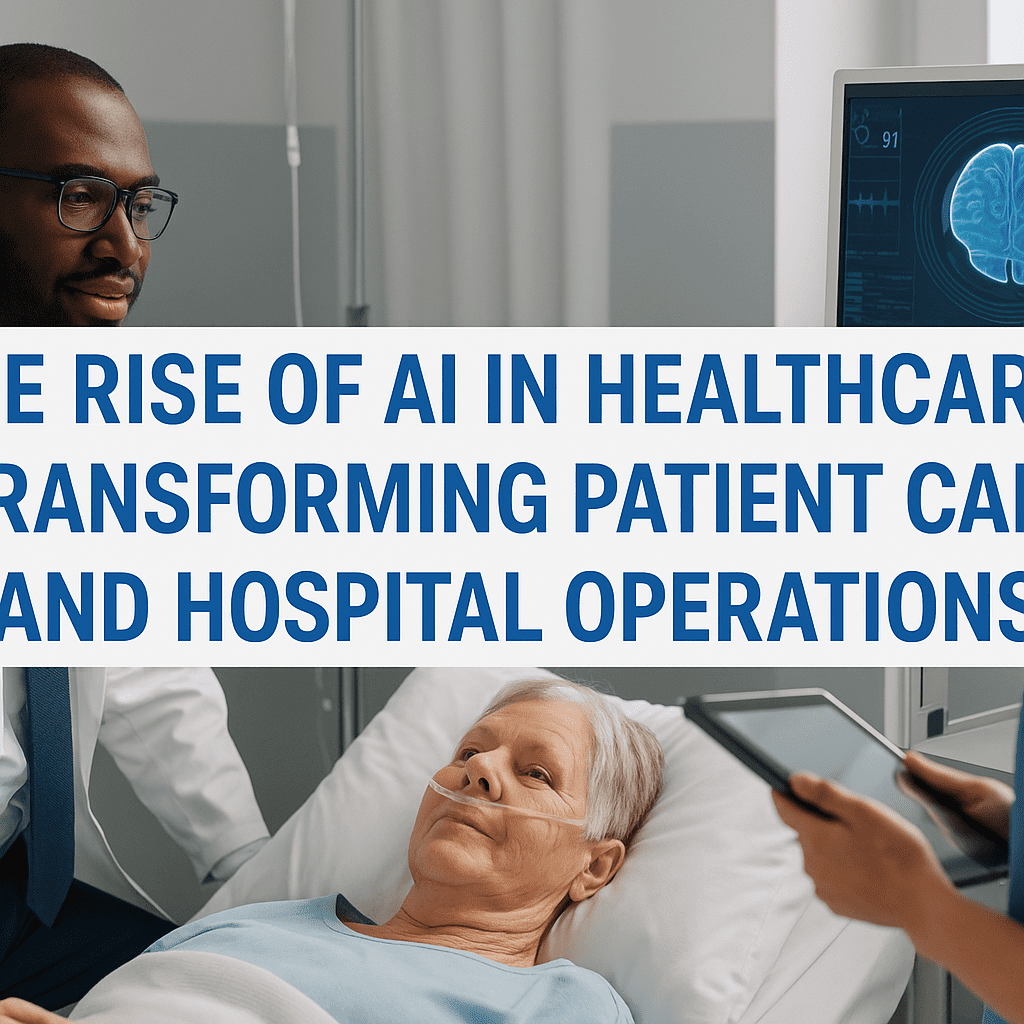
The Rise of AI in Healthcare — Transforming Patient Care and Hospital Operations
Published by SMPLSINNOVATION | February 2025
I. Introduction
If you’ve been to a hospital lately and thought an AI assistant might greet you at the front desk, you’re not wrong. By 2025, artificial intelligence in healthcare has gone from a far-off idea to an everyday tool. What used to be small research projects are now large systems that help with everything from reading MRI scans to scheduling nurses.
This big change is being driven by a few key things:
– The push for digital solutions during the pandemic.
– Better systems that allow health data to connect and work together.
– A shortage of doctors and nurses, which makes AI a helpful partner instead of a replacement.
In this post, we’ll look at how AI is changing both patient care and hospital operations, based on trusted reports from Nature Medicine, The Lancet Digital Health, the World Health Organization, and McKinsey HealthTech Insights.
II. The Current Landscape of AI in Healthcare
The world of healthcare AI is growing fast, with hospitals and tech companies all racing to use it.
– The global AI in healthcare market reached about 62 billion dollars in early 2025 and is expected to grow to 190 billion dollars by 2030.
– The leading countries using AI in health are:
1. United States – leading in AI for medical imaging and data analysis.
2. United Kingdom – using AI tools approved by the NHS.
3. Singapore – improving how national health data connects.
4. UAE – building AI command centers to run hospitals more smoothly.
5. Japan – using robotic AI to help care for elderly patients.
Most common AI models in use are:
– Diagnostic systems that help with scans, lab results, and skin checks.
– Predictive models that find risks for readmission, infection, or heart problems.
– Generative AI that helps write medical summaries and training materials.
– Robotic systems that assist with surgery and hospital logistics.
– Conversational AI that helps answer patient questions and support triage.
Regulators are keeping up too. The FDA in the U.S. has a new framework that lets AI models update safely, and the European Medicines Agency is testing new digital health tools.
The World Health Organization has also created rules for the safe and fair use of AI in health, making sure everyone receives proper care.
III. Transforming Patient Diagnostics and Treatment
1. Diagnostic Imaging and Radiology
AI can now read medical images with incredible accuracy. In many hospitals, AI tools help radiologists detect problems earlier and more reliably.
Common uses include:
– Cancer scans that spot very small tumors.
– Heart scans that detect plaque early.
– Chest X-rays that find signs of TB and COVID-19 damage.
– Cloud-based image sharing for expert review.
– Real-time alerts in emergency rooms that help doctors act faster.
2. Precision Medicine and Drug Discovery
AI is helping doctors create treatments that fit each person better. It can study huge sets of genetic data in minutes to find which treatments might work best.
Recent examples include:
– FDA-approved trials for rare cancers designed with AI.
– Finding new uses for existing medicines.
– Predicting protein structures to design new treatments.
– Matching patients to the right clinical trials.
– Adjusting medicine doses to reduce side effects.
3. Clinical Decision Support Systems
AI now helps doctors handle the huge amount of electronic health record data. It highlights important information and can even answer spoken questions.
Hospitals using these tools are seeing:
– Easier and faster chart reviews using natural language tools.
– Alerts that help prevent missed diagnoses.
– Voice systems that let doctors ask for key patient data during surgeries.
– Dashboards that help assign tasks and manage time better.
– Predictive triage that prioritizes patients who need urgent care.
IV. Enhancing Hospital Operations with AI
AI is also improving how hospitals run behind the scenes.
1. Operational Efficiency
AI helps hospitals use time, staff, and resources better.
Common examples are:
– Smarter nurse scheduling to reduce burnout.
– Predicting wait times in emergency departments.
– Forecasting bed needs.
– Organizing patient transport.
– Scheduling surgeries automatically.
– Managing stock and supplies.
– Maintaining equipment before it breaks.
– Controlling energy use in hospital buildings.
– Planning ambulance routes.
– Running hospital command centers that track patients and resources.
2. Administrative Automation
AI is also cutting down paperwork and routine tasks.
Examples include:
– Speeding up claims and insurance checks.
– Spotting billing errors.
– Writing discharge summaries automatically.
– Supporting insurance and scheduling assistants.
– Handling patient chat requests for pre-approvals.
– Predicting reimbursements.
– Summarizing medical histories quickly.
– Creating accurate medical transcriptions.
– Sorting non-medical messages to the right departments.
– Translating patient communication across languages.
3. Smart Infrastructure and Robotics
Hospitals are using AI with smart devices and robots to improve daily operations.
– Robots deliver medications, linens, and supplies.
– Smart systems manage light, temperature, and airflow.
– Predictive tools keep machines in good condition.
– Cleaning robots disinfect patient areas.
– Delivery systems move samples between labs and wards automatically.
All of this makes hospitals cleaner, safer, and more efficient.
V. Improving Patient Engagement and Outcomes
1. Virtual Care and Conversational AI
Many people now use AI chat tools that remind them to take medicine, schedule appointments, or find support late at night.
AI is helping patients by:
– Offering 24/7 chatbots that guide them to the right care.
– Virtual nursing that monitors long-term conditions.
– AI mental health programs that give advice and comfort.
– Explaining medical terms in simple language.
– Detecting emotions to adjust conversation style.
– Virtual rehabilitation support.
– Watching wearable health data and alerting doctors of changes.
– Predicting when telemedicine follow-ups are needed.
– Collecting patient feedback automatically.
– Protecting data with top-level privacy systems.
2. Predictive Analytics for Preventive Care
AI is turning healthcare into something that works every day, not just during checkups.
AI tools help prevent disease by:
– Detecting early signs of infection.
– Predicting heart problems before they happen.
– Estimating the chance of cancer returning.
– Finding patterns that may indicate diabetes early.
– Noticing when patients skip medication.
– Studying large groups to improve public health.
AI in healthcare is not about replacing doctors and nurses. It’s about giving them better tools, helping patients get faster answers, and making hospitals work more smoothly for everyone. As this technology grows, staying careful, ethical, and patient-focused will keep it a powerful force for good.