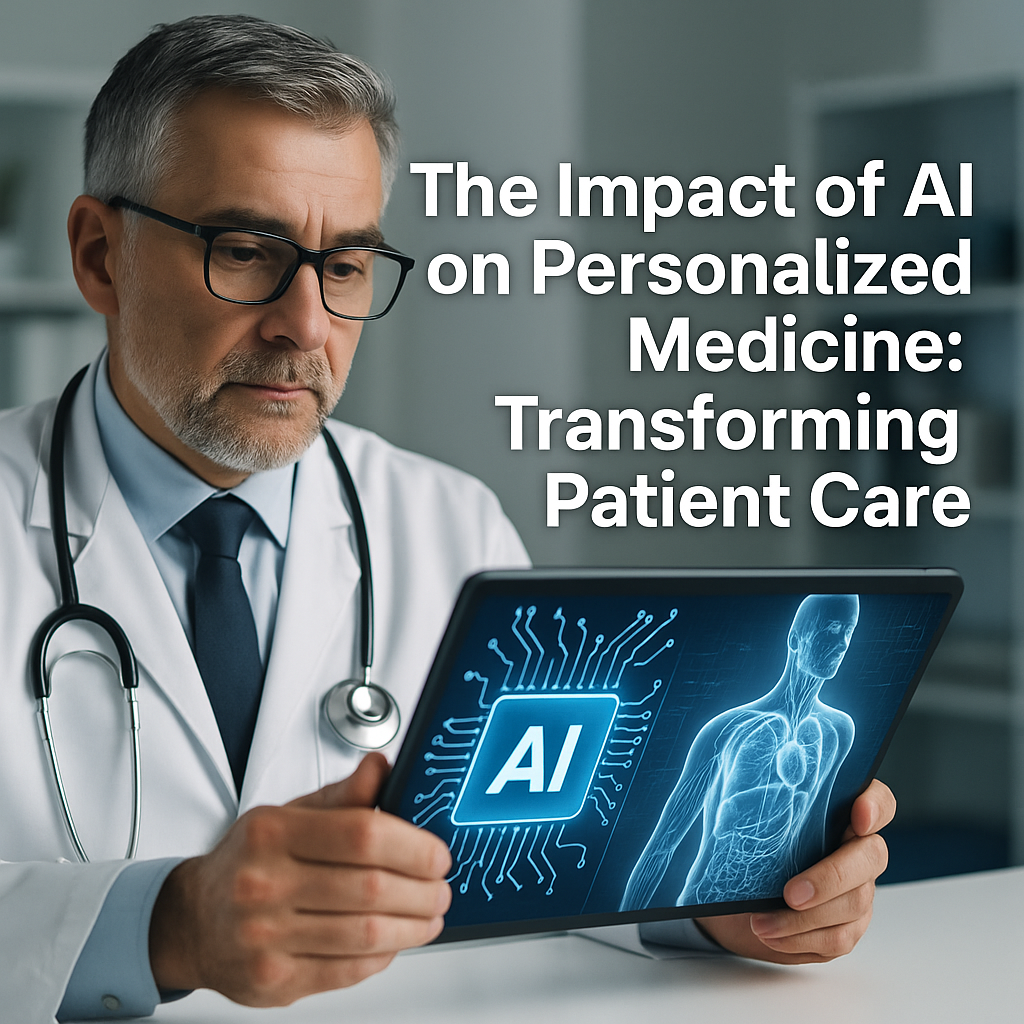
The Impact of AI on Personalized Medicine: Transforming Patient Care
Published: February 1, 2024
By: SMPLSINNOVATION
I. Introduction
If you have been around a hospital, science fair, or anyone excited about new technology lately, you have probably heard the words personalized medicine. It may sound fancy, but it really just means using information about each person to choose the best care for them. Artificial intelligence, or AI, is helping doctors and researchers understand people’s health faster and more accurately than ever before.
Personalized medicine focuses on each person’s unique genes, environment, and lifestyle. Instead of giving everyone the same treatment, doctors can now create plans made just for you. AI helps make this possible by using computer programs that learn from large amounts of data.
Today, we will look at how AI is changing the way medicine works, making care more personal, precise, and predictive.
II. The State of Personalized Medicine in 2024
Science and technology are growing quickly. In 2023, the personalized medicine market was worth about 620 billion dollars and is expected to reach over 900 billion by 2027. This is because AI is getting better and data sharing is improving around the world.
Three things are driving this change:
1. AI has grown up. It is now used in hospitals and clinics to make real-time decisions.
2. Governments and organizations are creating clearer rules for how AI systems should be tested and managed.
3. Countries are working together and sharing genetic and health data to make new discoveries faster.
Of course, there are also challenges. People are asking important questions about fairness and privacy. Can AI systems be fair to everyone? Who owns the health data? And can we make AI explain its decisions clearly?
III. How AI Powers Personalized Medicine
AI helps doctors and scientists understand how diseases work and how treatments can be improved. It can analyze complex information much faster than humans.
Here are some key ways AI helps personalized medicine:
1. It studies different types of data, such as genes and proteins, to understand diseases better.
2. It groups patients with similar health patterns so doctors can design the best care for each group.
3. It combines data from hospitals, wearable devices, and health records to give a full picture of each patient.
Some top AI tools used today include:
1. Deep learning systems that read genetic information.
2. AI programs that find new uses for old medicines.
3. Predictive models that spot diseases before symptoms appear.
4. Smart systems that adjust clinical trial plans as data changes.
5. Tools that read and organize doctors’ notes automatically.
6. Federated learning, which lets hospitals work together without sharing private data.
7. Digital twins that simulate how treatments might work for each person.
8. Imaging tools that study scans to predict disease risks.
9. AI tools that find new biomarkers for faster diagnosis.
10. Chatbots that remind patients to take medicine or check in with doctors.
AI is not replacing doctors. It is helping them give better care and helping patients take a bigger role in their own health.
IV. Case Studies: Real-World Examples
Here are a few examples of how AI is already helping patients:
1. In cancer treatment, AI can study tumor DNA to suggest the right therapy and even adjust doses in real time.
2. In heart care, AI uses scans and wearable data to predict heart problems before they happen, helping prevent heart attacks.
3. For rare diseases, AI can find answers in hours instead of years by comparing genetic patterns quickly and accurately.
These examples show how AI helps doctors save lives and make faster, more precise decisions.
V. Data and Ethics
As AI grows, it needs large amounts of data to learn. This raises important questions about fairness, privacy, and safety.
Some key challenges include:
1. Different hospitals and labs often store data in different systems that do not connect well.
2. Even when data is made anonymous, it can sometimes still be traced back to a person.
3. Most AI training data comes from certain countries, which can lead to unfair results for others.
There are also new rules to guide this work. The European Union and the U.S. FDA both updated their policies in 2024 to make sure AI in healthcare is safe and transparent. The NIH also created a framework to make AI fair and open in research.
To keep AI in medicine trustworthy, developers and researchers need to follow four main rules:
1. Everyone should have equal access to AI-powered healthcare.
2. Patients must always give clear and informed consent.
3. AI decisions must be explained and traceable.
4. Developers should use energy wisely and keep computing sustainable.
VI. New Trends in 2024
Researchers are finding even more creative ways to use AI. Some of the newest studies show:
1. AI can combine information from genes, gut bacteria, and other sources to find disease risks early.
2. AI can teach itself from new data over time, improving just like a doctor learns with experience.
3. Doctors are now using virtual models of patients’ hearts to see how different treatments might work.
Other exciting projects include using AI to estimate health risks, create custom medicine doses, coach patients through phone apps, and link health data with environmental factors like weather and pollution.
AI is helping healthcare move from reacting to problems to predicting and preventing them. With careful use, it can bring safer, fairer, and more personal care to everyone.