Remote Patient Monitoring in Australian Home Care: Benefits, Challenges, and Future Trends
By SMPLSINNOVATION – your friendly Australian health-tech consulting team keeping care simple, smart, and cheerful.
I. Introduction
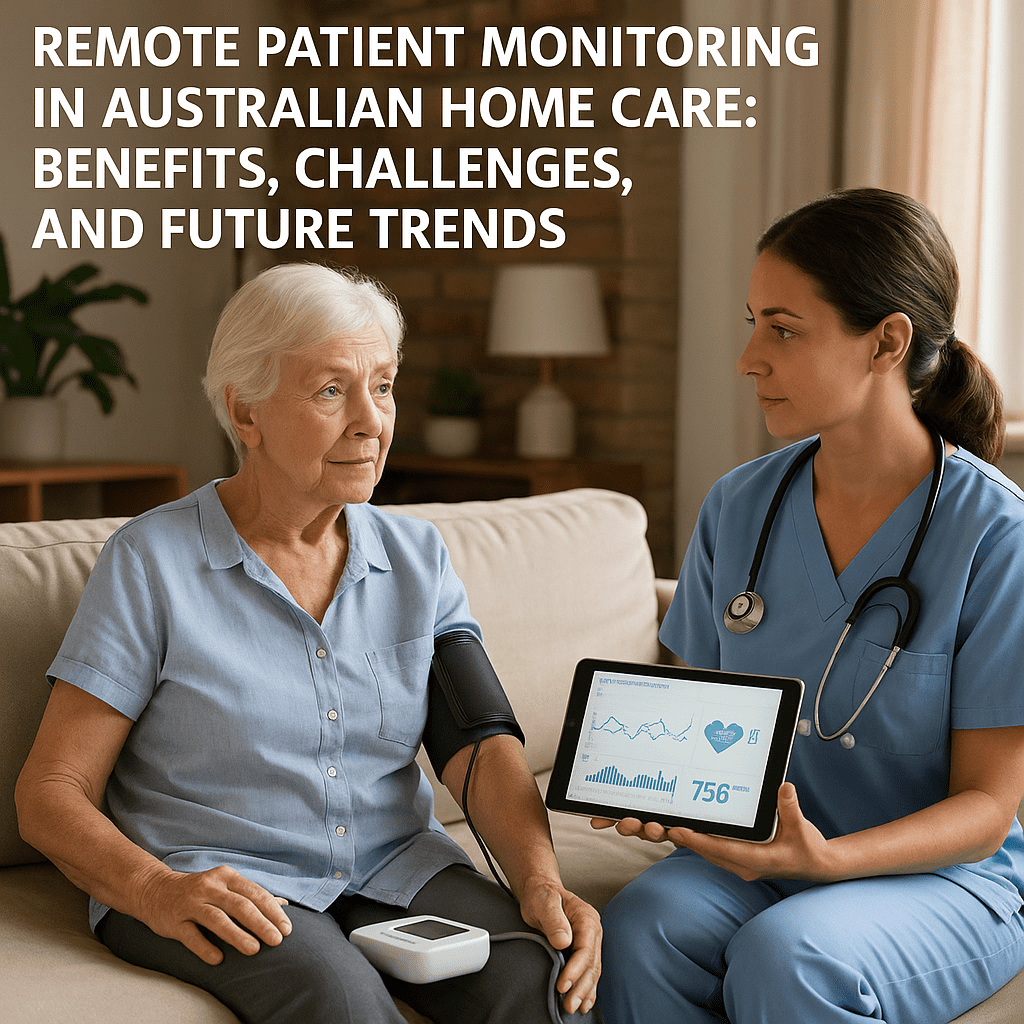
Imagine this: your smartwatch beeps softly, showing that your heart rate and blood pressure look good. Your doctor gives you a virtual thumbs-up — all while you’re sitting on your couch. Welcome to Remote Patient Monitoring, or RPM. It’s like having a nurse, helper, and coach wrapped into one clever piece of technology.
By 2025, home care in Australia looks very different from just a few years ago. With more people getting older, the Australian Digital Health Agency and the Department of Health and Aged Care are using new digital tools like RPM to help people stay healthy at home. According to the Australian Institute of Health and Welfare, more than 4 million Australians now receive some kind of care at home. RPM is helping to take pressure off hospitals and aged care homes.
The goal of this blog is to explain what RPM is, how it’s changing home care, what challenges it brings, and what the future might look like.
II. Understanding Remote Patient Monitoring (RPM)
So, what is RPM? It’s a way for patients and doctors to share health information without always meeting in person. Patients use special devices that track things like heart rate, blood pressure, and oxygen levels. This information goes straight to doctors and nurses who can check it anytime.
Core RPM Technologies
1. Wearable sensors that track heart rate, oxygen, movement, and sleep.
2. Smart devices like blood pressure cuffs and glucose meters that connect online.
3. Voice assistants that remind people to take medicine or drink water.
4. Cloud systems where doctors can watch many patients at once.
5. Smart alerts that tell nurses when something seems wrong.
RPM is not the same as telehealth. Telehealth focuses on online doctor appointments, while RPM watches patients’ health between those visits. Both are important parts of Australia’s digital health plan.
My Health Record now links with RPM systems, making it easier for doctors to access patient data. That means smoother, safer care.
III. The Rise of RPM in Australian Home Care
Since 2023, RPM has become a big part of home care in Australia. So what’s behind the growth?
Key Reasons for Growth
1. Government programs that support digital health tools.
2. More people living with long-term health problems like diabetes.
3. A shortage of health workers, especially in rural areas.
4. People wanting easier and faster health care.
5. COVID-19 made virtual care more common.
6. Better internet and 5G connections.
7. Lower device costs.
8. Hospitals testing virtual wards.
9. New funding models that reward good results.
10. Fewer car trips mean better for the planet.
Real Examples
• Silverchain’s program showed a 22% drop in hospital readmissions in 2024.
• Monash Health’s Virtual Ward supported over 1,200 patients with constant monitoring.
• Healthdirect Australia added RPM tools to its online care services.
Experts think that by 2030, the Australian RPM market could be worth more than 1.8 billion dollars.
IV. Benefits of Remote Patient Monitoring in Home Care
RPM has many benefits for patients, families, care providers, and the whole health system.
For Patients and Families
1. More independence for older adults.
2. Early signs of problems get caught faster.
3. Fewer hospital visits.
4. Peace of mind for loved ones.
5. Better understanding of personal health.
6. Helpful reminders for medicine.
7. Easy access to remote help.
8. Less worry about sudden health changes.
9. Personalised care based on real data.
10. Tools to prevent falls and improve mobility.
For Healthcare Providers
1. Quicker identification of urgent cases.
2. Constant patient data instead of occasional checkups.
3. Less time spent on paperwork.
4. Easier connection with GPs and specialists.
5. Better medication tracking.
6. Fewer false alarms with smarter systems.
7. Ability to care for more patients safely.
8. Stronger relationships through regular updates.
For the Health System
1. Less pressure on emergency departments.
2. Lower overall costs.
3. More hospital beds available for serious cases.
4. Better nationwide data for planning.
5. Easier care handovers between hospital and home.
6. Better prevention and early detection.
7. Stronger public health outcomes.
Recent studies from 2024 and 2025 showed:
• 35% fewer hospital readmissions for heart patients.
• 28% fewer emergency visits for those with breathing issues.
• 85% of people took their medicines on time when reminded digitally.
• 97% satisfaction among older people in care programs.
• 50% less caregiver travel stress.
• 40% faster responses to sudden health changes.
• Hospital stays up to five days shorter after discharge.
V. Challenges and Barriers to Implementation
Of course, RPM has its difficulties too.
Technical Challenges
1. Devices sometimes can’t connect with all hospital systems.
2. Some areas still have poor internet.
3. Devices need accurate calibration.
4. Data needs to be kept private and safe.
5. Systems must follow Australian privacy laws.
6. Technology updates can be costly.
7. Too many software options make integration hard.
8. Users and staff need training.
9. Devices use energy and require maintenance.
10. Old systems don’t always work well with new ones.
Cultural and Operational Challenges
1. Some care workers resist digital changes.
2. Older adults may find devices confusing.
3. It’s not always clear who should pay for equipment.
4. Some people fear losing the personal side of care.
5. Not enough clear rules for RPM use.
6. Complicated funding and pay systems.
7. Ethical questions about privacy versus safety.
8. Need for constant tech support.
9. Balancing automation with human care.
VI. Future Trends and Opportunities
So what’s next for RPM in Australia?
Trends to Watch
1. Smarter monitoring that predicts problems before they start.
2. More virtual wards providing hospital-level care at home.
3. Tools that track mood and mental health.
4. Fun apps that turn healthy habits into games.
5. New technology to keep patient data safe.
6. Faster and smoother real-time monitoring through 5G.
7. Devices that can process more data on their own.
As technology improves, remote care will become even more common, making it easier for Australians to live safely and independently at home while staying connected to their care teams.